


Activon Tube
100% Medical Grade Manuka honey
Product Description
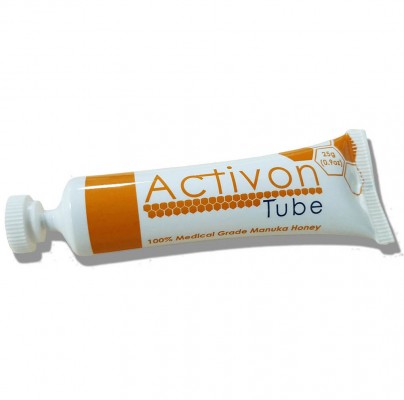
Activon Tube contains 100% Manuka honey from New Zealand. Unlike some manufacturers, we don’t add anything to it – the whole tube is 100% Manuka honey.
Activon Manuka Honey is filtered and sterilised making it suitable for use on wounds.
Not sure which Activon Manuka Honey dressing you need?
Activon Manuka Honey is filtered and sterilised making it suitable for use on wounds.
Not sure which Activon Manuka Honey dressing you need?
Use
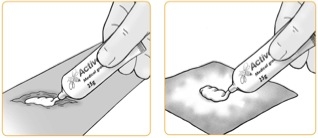
Twist off the cap and apply directly to the wound, or dressing if topping up. Secure with an appropriate secondary dressing. Single patient use. Can be used up to 90 days after opening.
Initially you may experience high levels of exudate, this is perfectly normal and will decrease over time, therefore your secondary dressing of choice may initially need to be a superabsorbent dressing, we recommend Eclypse.
Top tip
Use Activon Tube in conjunction with Algivon for debriding and de-sloughing.
Click here for Instructions For Use
Initially you may experience high levels of exudate, this is perfectly normal and will decrease over time, therefore your secondary dressing of choice may initially need to be a superabsorbent dressing, we recommend Eclypse.
Top tip
Use Activon Tube in conjunction with Algivon for debriding and de-sloughing.
Click here for Instructions For Use
Use
Twist off the cap and apply directly to the wound, or dressing if topping up. Secure with an appropriate secondary dressing. Single patient use. Can be used up to 90 days after opening.
Initially you may experience high levels of exudate, this is perfectly normal and will decrease over time, therefore your secondary dressing of choice may initially need to be a superabsorbent dressing, we recommend Eclypse.
Top tip
Use Activon Tube in conjunction with Algivon for debriding and de-sloughing.
Click here for Instructions For Use
Initially you may experience high levels of exudate, this is perfectly normal and will decrease over time, therefore your secondary dressing of choice may initially need to be a superabsorbent dressing, we recommend Eclypse.
Top tip
Use Activon Tube in conjunction with Algivon for debriding and de-sloughing.
Click here for Instructions For Use
Indications
Activon® Tube may be applied to any type of wound and is especially useful for cavity wounds. It may also be used to top up other dressings in the Activon® Manuka Honey range where the honey has been washed away by exudate.
Contra-indications
Known allergy to bee venom/honey.
Ordering
| Product | Size | Stock Code | Pack Size | NHS Code | PIP Code |
Activon Tube | Size: 25g | Stock Code: CR3830 | Pack Size: 12 | NHS Code: ELZ069 | PIP Code: 319-3729 |
Literature
Clinical evidence
- A clinical evaluation of Algivon Plus Manuka honey dressings for chronic wounds
- A positive review of Manuka honey dressings
- A prospective evaluation of the use of honey dressings to manage burn wounds - Jacky Edwards Wounds UK
- A successful combination: Teicoplanin & Manuka honey in the management of cellulitic wounds - Kate Owen
- Actilite® & Algivon® in the treatment of dorsal & plantar superficial ulcers
- Actilite® on a venous ulcer
- Activon® honey in the treatment of a fungating tumour
- Activon® Manuka honey dressings used aboard Mercy Ships
- Activon® Manuka honey in diabetic patient with digital ulceration
- Activon® Manuka honey in the treatment of a paediatric severe scald to the face & neck
- Activon® Tube & Actilite® on a paediatric burn
- Activon® Tube used on foot ulcerations following a chemical burn injury
- Activon® Tulle & Actilite® as a primary dressing under compression for a Lymphoedema patient
- Activon® Tulle & Actilite® as a primary dressing under compression for a Lymphoedema patient
- Activon® Tulle in the treatment & prevention of MRSA, an effective treatment for chronic wound infections
- Activon® Tulle on a 67 year old male patient with Grade 4 pressure ulcer
- Algivon® & Actilite® in the treatment of ischaemic ulceration of the foot
- Algivon® in the treatment of a traumatic amputation to the right ring finger
- Algivon® on chronic lymphoedema and recurring cellulitis
- Collaborative working in healing a chronic wound of two years, in eight weeks using Manuka honey
- Debridement of chronic leg ulcers with Algivon®
- Do honey - impregnated dressings affect glycaemic control? Pam Kirkby,
- Do honey dressings reduce the need for antibiotics?
- Efficacy of medical grade honey as an autolytic deridement agent - Julie Evans, Kirsty Mahoney
- Evaluation of a Honey dressing on wounds within Primary Care
- Evaluation of Actilite®
- Inhibition of biofilms through the use of Manuka honey - Rose Cooper, Leighton Jenkins, Richard Rowlands Wounds UK
- Is Honey the Bees’ Knees?
- Is Manuka honey a credible alternative to silver in wound care? - Rose Cooper, David Gray
- Manuka honey in wound management: greater than the sum of it's parts? - Richard White
- Providing a Burns Service in Northern Tanzania - Catherine Hadall
- The complexities of wound healing
- The debriding activity of of 100% Manuka honey dressings in different wound etiologies
- The determination of antimicrobial activity of three honey impregnated wound dressings by challenge test with EMRSA-15
- The effectiveness of multiple debridement techniques in a case featuring extensive ulceration and necrosis to both feet
- The effects of Activon® manuka honey on a non-compliant patient with chronic venous leg ulcers
- The effects of Activon® Tube on a patient with Type 2 Diabetes
- The long term use of honey dressings on ischaemic feet
- The use of Actilite® and Algivon® in the treatment of dorsal & plantar superficial ulcers
- The use of Actilite® dressing and four layer bandages in the management of venous leg ulceration
- The use of Actilite® on a venous leg ulcer
- The use of Actilite® on severe bilateral leg ulcers
- The use of Activon® Manuka honey on electrical burns
- The use of Activon® Tube & Activon® Tulle on the treatment of necrotic foot, heal & shin
- The use of Activon® Tube and Algivon® on an elderly male diabetic patient with a grade 5 sacral wound
- The use of Activon® Tube on foot ulceration following a chemical burn injury on a patient with Diabetic Peripheral Sensory Neuropathy
- The use of Activon® Tulle dressing on extensive cellulitis of the right leg
- The use of Activon® Tulle on a venous ulcer
- The use of Activon® Tulle on an overgranulated grade 3 pressure ulcer
- The use of Advancis Manuka honey dressing on a grade 4 pressure ulcer
- The use of Advancis Manuka honey dressings used on pressure sores in the Centre for the Rehabilitation of the Paralysed in Bangladesh
- The use of Advancis Manuka honey on a burn to the lower leg
- The use of Algivon® in the treatment of a traumatic amputation to the right ring finger distal to the DIP joint
- The use of Algivon® on a burn to the face, neck & scalp
- The use of Manuka honey dressing on the treatment of ulcerations caused by Necrobiosis Lipoidica Diabeticum
- The use of Medical Grade Manuka honey to facilitate auto-amputation of fingertip necrosis - Sian Cryer
- Use of Activon® Manuka honey on a burn to the lower leg
- Use of Advancis Medical Grade Manuka honey in the diabetic patient with digital ulceration, synovial involvement & osteomyelitis
- Use of Algivon® & Advazorb® in treatment of a plantar ulcer on an elderly patient
- Use of Honey in Managing Burn Wounds
- Using Activon® medical grade Manuka honey with diabetic foot ulcers
External Resources
Honey as a topical antibacterial agent for treatment of infected wounds.
Molan. P December 2001
Odour Absorbing Dressings: A comparative laboratory study
Thomas P : April 1998 : Worldwidewounds.com
Molan. P December 2001
Odour Absorbing Dressings: A comparative laboratory study
Thomas P : April 1998 : Worldwidewounds.com
Brochure
Guides
- Actilite® Non-adherent viscose net dressing coated with 99% Manuka honey and 1% Manuka oil
- Activon® Tube 100% Medical Grade Manuka honey
- Activon® Tulle Knitted viscose mesh impregnated with 100% Manuka honey
- Algivon® Alginate dressing impregnated with 100% Manuka honey
- Algivon® Plus Reinforced alginate dressing impregnated with 100% Manuka honey
- Algivon® Plus Ribbon Reinforced alginate ribbon impregnated with 100% Manuka honey
FAQ
- 1. Can Activon honey be used under compression bandaging?
- The Activon range can be used under compression bandaging. The amount of exudate would influence your choice of Algivon, Activon Tulle or Actilite with an appropriate absorbent secondary dressing such as Eclypse. As compression bandaging is ideally designed to be left in place for a full week Algivon may be appropriate due to the fact that, in the presence of exudate, the alginate fibres swell, forming a sodium-calcium gel on their surface which combines with the honey. The resulting honey-gel complex prolongs the retention of honey at the wound site, increasing effectiveness. The secondary dressing must be appropriate to the exudate level and will influence wear time.
- 2. Can Activon Tulle or Algivon be folded and put into a cavity?
- Both dressings could be put into a cavity wound, again dependant on exudate levels. If there is a possibility of sinus within the wound base then Activon Tube should be used to ensure that the honey reaches the entire wound bed.
- 3. Can the Activon Tulle be unfolded to apply?
- Activon Tulle can be unfolded and applied, however this will reduce the level of honey at the wound bed. The triple layer of the gauze delivers the optimum amount of honey to the wound bed therefore unfolding the dressing would affect efficacy.
- 4. Can your Manuka honey dressings be used on diabetic patients?
- While there is no known case of honey influencing blood glucose levels adversely, it is recommended that the blood sugar levels of patients with diabetes are monitored when using honey.
- 5. Does the honey sting on application?
- There have been reports of honey causing a stinging pain when applied to the wound. This appears to be due to the acidity of honey, as pain is not experienced when neutralised honey is used. The pain experienced does not seem to be indicative of damage being done to the wound, as wounds have healed rapidly in cases where patients have endured the pain to benefit from the stimulation of healing that they see, and in cases where analgesia has been used.
There is evidence that honey stimulates nocioceptors (Al-Swayeh and Ali, 1998), nerve endings that create a pain sensation in response to heat, acidity and some organic chemicals. It may be that it is not a direct effect of the acidity of honey, as neutralising honey could affect the ionisation of some of its components and make them unable to fit in the nocioceptors. It is possible that in some patients these nerve endings are sensitised and are more responsive to the acidity and/or the component organic chemicals of honey. - 6. How do you know whether to use Algivon or Activon Tulle?
- This would be dependant on the grade of wound and the level of exudate. In a heavily exuding or necrotic wound your choice would be Algivon however if the wound is producing moderate exudate then Activon Tulle would be the dressing of choice.
- 7. How long can the honey dressings be left on the wound for?
- The dressings can be left in place for up to seven days, again this would depend on the exudate levels produced by the wound and the appearance of the dressing. As long as the dressing has maintained it’s original colour (the honey is present) it can remain in situ.
- 8. What are the contra indications for your Manuka honey?
- Known allergy to bee-venom. Although no known instance of increased levels of blood sugar in patients with diabetes. It is advisable to closely monitor the levels. Increased pain may be experienced due to acidification.
- 1. Test
- Matt test
- 2. Test 2
- Matt test 2


